

Published 5 min read
Words with a dotted underline? Hover, focus or tap for a quick explanation.
The short answer: I'm not against WordPress. I just don't think every small-business website needs it. If all you want is a professional site that explains what you do, shows your work and makes it easy to contact you, I generally prefer to build it specifically for that job. And if you want WordPress, I'm happy to discuss using it.
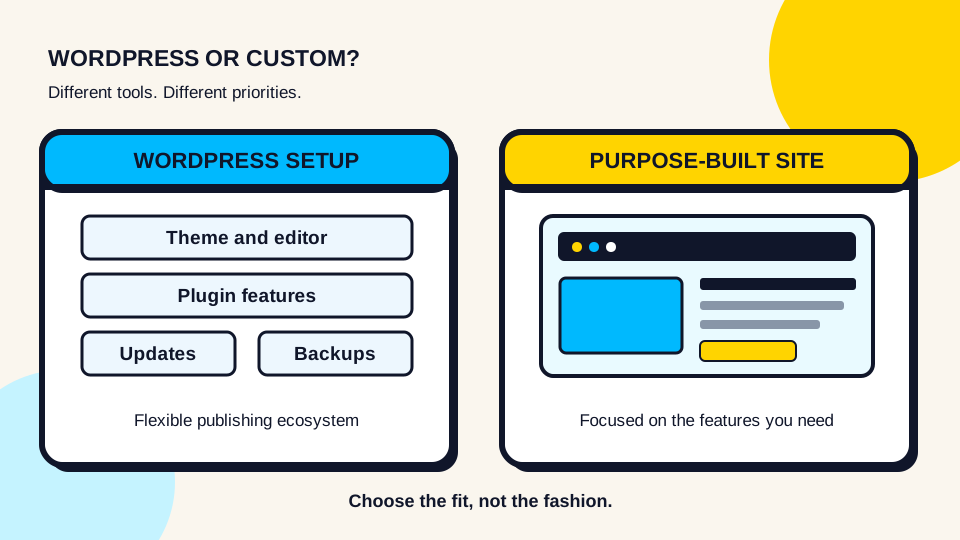
WordPress isn't bad. It's often more than you need.
WordPress started as a publishing platform and has grown into a very flexible way to run websites. That flexibility is a real strength. Themes, plugins and an editing dashboard let people build a lot without starting from scratch.
But I often see a straightforward business website become a stack of moving parts: a theme, a page builder, a form plugin, an SEO plugin and more. Each might be useful individually. Together, they can create extra updates, subscriptions and compatibility checks for a site that only needed a handful of features. Not every WordPress site ends up like that, and a well-built WordPress site can work beautifully.
Why I lean toward custom-built sites
Less software to look after
A simple site with your services, photos, contact details and a quote form does not always need WordPress, a theme, a page builder and several plugins. Every extra component is something to evaluate and maintain.
Built around the business
I can focus on the pages and features your customers actually use, rather than adapting your business to a particular theme or plugin. That might mean a simple one-page website or a more tailored booking, product or enquiry flow.
Performance without unnecessary extras
A smaller, purpose-built site can avoid loading features it never uses. That can make speed and accessibility easier to optimize, although neither custom code nor WordPress is automatically fast. The finished site still has to be tested.
Clearer ongoing costs
I would rather explain the cost of hosting, changes and any outside services than add subscriptions because a template needs another plugin. Custom features also have costs, so I compare the actual work instead of assuming custom is always cheaper.
For a local contractor, shop or service business, the right answer may be one well-designed page with clear sections. A growing business might need dedicated service pages, galleries, appointments or a store. I'd rather choose the features first and then the technology. If you want a starting point on budget, see my Manitoba website cost guide.
What about security and maintenance?
This is one of my biggest considerations. WordPress itself is actively maintained and supports automatic updates. Plugins and themes also need attention, and updates can occasionally affect how a site works. WordPress's own documentation recommends keeping them current and maintaining backupsSaved copies of website data or files that can help restore a site after a problem..
A custom website isn't magically secure or maintenance-free, either. Its dependencies, hostingThe service that keeps your website's files and features available on the internet., forms, integrations and any private data still need proper care. My preference is simply to avoid introducing systems that the project doesn't need, and to test and maintain the ones it does.
If you want to understand what ongoing care actually covers, I break it down in my hosting vs maintenance guide.
When would I recommend WordPress?
There are good reasons to choose it. I'd absolutely consider WordPress when:
- Your team publishes articles or updates frequently and already likes the WordPress editor.
- You have an established WordPress site that works well; rebuilding it would create cost without enough benefit.
- A proven WordPress or WooCommerce feature fits a complex requirement better than commissioning something new.
- Your staff, agency or other provider needs a familiar WordPress workflow.
- You simply prefer WordPress. It's your website, and your preference matters.
I don't believe in rebuilding a working site just for the sake of using different technology. I'd compare its current problems, expected lifespan, migration work and the actual benefit first.
Can I still edit a custom website?
Yes, when editing is part of the plan. We can build a simple way to manage the content you change regularly, or agree on managed content updates. For a site that rarely changes, you might not need a dashboard at all. The important part is deciding that up front, rather than assuming a custom site includes a self-service editor by default.
You should also know who controls your domainYour website's address, such as sitesbymike.ca. You register and renew it separately from building the site., what content and files you receive, how SEOSearch engine optimization: improving your website's content and setup so search engines can understand it and people can find it. basics are handled, and how you could move to another provider. Different frameworks and external services have different handoff requirements. I'll explain those before we build.
My rule: choose the website, then choose the tools.
If a lean custom site is the best fit, that's where I'll start. If WordPress makes more sense for your content, workflow or existing investment, we can use it. You should end up with the right website for your business, not the one that happens to be easiest for a developer to sell.
For independent reference, see WordPress's own plugin and theme update guidance and plugin management documentation.